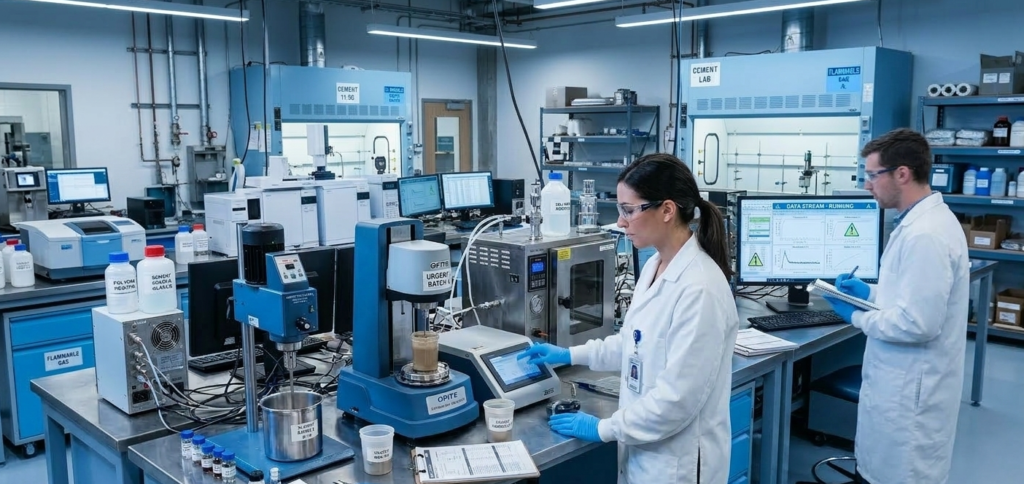
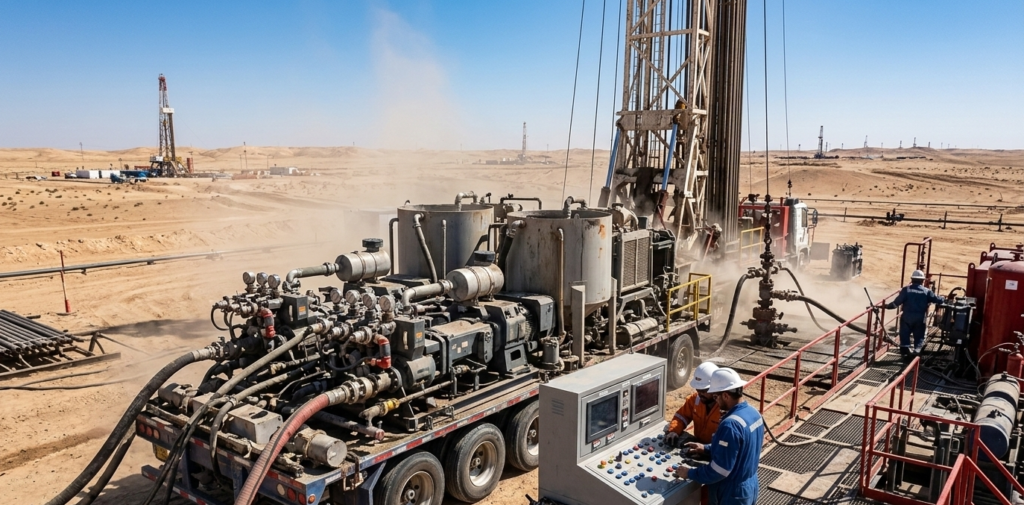
Well cementing remains one of the most critical processes in oil and gas well construction. The cement sheath provides structural support for casing, prevents formation fluid migration, and ensures long-term well integrity. However, as wells become deeper and more complex (often encountering high-temperature, high-pressure (HPHT) environments and extended reach drilling conditions) the performance requirements for cement slurries have increased significantly.
Recent advances in cementing additives are transforming how operators design cement systems. From nanomaterials to advanced polymer chemistry, modern additives improve slurry stability, control fluid loss, and enhance the mechanical integrity of the cement sheath.
These technological developments are particularly important for operators working in complex reservoirs across the Middle East, where well integrity and zonal isolation are critical for long-term production.
Emerging Technologies in Cementing Additives
Polymer-Based Fluid Loss and Rheology Modifiers
Advanced polymer chemistry continues to dominate cement additive development. Modern copolymers and synthetic polymers are widely used to regulate slurry viscosity, reduce fluid loss, and control thickening time.
Recent studies show that polymer additives can reduce cement slurry fluid loss to below 20 mL in laboratory tests, while improving pore structure and cement hydration stability.
Many of these polymers rely on AMPS-based sulfonated monomers, which provide excellent temperature and salt resistance—making them ideal for deep and HPHT wells.
In practice, these additives are commonly combined with dispersants, retarders, and fluid-loss agents available within the Aquaness cementing additives portfolio:
These products allow drilling and completion engineers to maintain predictable rheology across wide temperature ranges while ensuring effective cement placement.
Nanomaterials and Nanocomposite Cement Systems
Nanotechnology is one of the most promising frontiers in cementing chemistry.
Researchers are increasingly incorporating nanoparticles such as:
- nano-silica
- nano-magnesia
- carbon nanotubes
- polymer nanocomposites
These materials significantly improve cement microstructure and durability.
For example, recent studies demonstrate that nanocomposite cement systems can increase compressive strength by more than 30% while simultaneously reducing permeability in hardened cement.
Such performance improvements help reduce the risk of micro-annulus formation, a common cause of sustained casing pressure in oil and gas wells.
Nanotechnology-enhanced cement systems also require compatibility with other drilling and completion chemicals. In many cases, engineers evaluate these interactions alongside drilling fluid additives and spacer systems during laboratory testing.
Related Aquaness products supporting these workflows include:
Mineral and Clay-Based Cement Performance Enhancers
Beyond synthetic polymers, researchers are exploring natural mineral additives to improve slurry stability.
For example, recent studies on kaolinite clay additives show that adding small quantities to cement slurry formulations improves rheology, reduces particle settling, and enhances compressive strength.
These additives are particularly useful for high-density cement systems, which are often used in deep wells to control formation pressure.
Field applications frequently combine these mineral additives with dispersants and fluid-loss control agents from integrated upstream chemical programs such as those supplied by Aquaness:
Gas Migration Control and Annular Integrity
Gas migration during cement setting remains a major well integrity risk.
During the transition period between slurry placement and final cement setting, gas can invade the cement column and create micro-channels in the annulus.
To mitigate this issue, modern cement systems use specialized additives such as:
- latex polymers
- fiber reinforcement materials
- nanoparticle accelerators
- gel-strength enhancers
These additives accelerate gel strength development and block gas pathways within the cement matrix.
Extensive laboratory testing is required to validate these systems under simulated downhole conditions before deployment.
Aquaness provides laboratory testing services in the UAE that help operators evaluate cement slurry performance under realistic well conditions:
Sustainability Trends in Cementing Technology
Another important development in cementing chemistry is the emergence of low-carbon and geopolymer cement systems.
These systems replace a portion of conventional Portland cement with alternative materials such as:
- fly ash
- blast furnace slag
- metakaolin
Research shows that geopolymer cement systems can significantly reduce CO₂ emissions while maintaining comparable mechanical strength and durability.
As energy companies increasingly prioritize ESG and sustainability metrics, these alternative cement systems are expected to become more widely adopted in upstream operations.
Translating Laboratory Innovation into Field Performance
Although laboratory discoveries are essential, successful cementing ultimately depends on field validation.
Before new additives are used in drilling operations, engineers perform extensive laboratory testing, including:
- High-temperature rheology measurements
- Thickening time analysis
- Fluid loss testing
- Free water measurements
- Compressive strength development
- Compatibility testing with drilling fluids
Advanced analytical methods such as FTIR chemical analysis and Demulsifier Bottle Testing are also used to evaluate fluid interactions during well construction.
These analytical workflows ensure that cement systems remain stable when exposed to drilling fluids, spacer fluids, and reservoir hydrocarbons.
Aquaness Cementing Chemicals and Technical Support in the UAE
Implementing advanced cementing technologies requires not only innovative additives but also reliable supply chains and technical expertise.
Aquaness provides a comprehensive range of cementing additives in the UAE, supporting drilling and completion operations across the region.
Explore Aquaness cementing chemicals
These products are designed to integrate seamlessly with upstream chemical programs and drilling fluid systems used in modern well construction.
Laboratory Testing in the UAE for Cementing Optimization
Aquaness also supports operators through laboratory testing services in the UAE, which help evaluate and optimize cement slurry formulations before field deployment.
Testing capabilities include:
- Cement slurry rheology and thickening time analysis
- Fluid loss and free water testing
- Compatibility studies with drilling fluids
- Chemical interaction testing using FTIR
- Demulsifier Bottle Testing for crude oil separation performance
Learn more about Aquaness laboratory capabilities
These services help operators reduce operational risks and improve cementing reliability.
Chemical Storage and Logistics Support in Dubai
Reliable logistics are essential for drilling campaigns.
Aquaness provides chemical storage services in Dubai, ensuring safe handling, inventory management, and rapid delivery of cementing additives and upstream chemicals.
Key advantages include:
- Secure storage facilities
- Controlled chemical handling environments
- Regional distribution support for drilling operations
- Compliance with UAE regulatory standards
These logistics services allow operators to maintain continuous drilling operations without supply chain disruptions.
Industry-Recognized Chemical Supply
Aquaness supplies chemical systems that are compatible with products used by major oilfield service companies, including:
- Halliburton
- NESR
- OILSERVE
This compatibility helps ensure that Aquaness cementing additives can be integrated easily into existing service company workflows and cementing programs.
Conclusion
The science of oil-well cementing continues to evolve rapidly. Advances in polymer chemistry, nanotechnology, mineral additives, and sustainable cement systems are enabling stronger and more durable cement sheaths capable of withstanding the extreme conditions of modern wells.
However, successful implementation requires more than innovative chemistry. Laboratory validation, supply chain reliability, and technical expertise are equally important.
Through its cementing additives portfolio, laboratory testing services in the UAE, demulsifier bottle testing capabilities, and chemical storage infrastructure in Dubai, Aquaness supports operators in deploying advanced cementing technologies that enhance well integrity and operational efficiency.
Explore Aquaness upstream chemical solutions
Explore how Aquaness can support your next cementing job:
Cementing Additives —
Upstream Chemicals Portfolio —
Lab Testing Services (UAE) —
For tailored cementing chemistry consultations or job design support, contact Aquaness today.
📩 info@aquaness.ae
📞 +971-564 158 644